Southern California Hospital Discharge Planning: How RASCC Helps With Difficult Post-Acute and Assisted Living Placements

RASCC helps Southern California discharge teams navigate complex post-acute transitions and find appropriate assisted living and residential care placements.
For hospital case managers, skilled nursing facility social workers, and rehabilitation discharge planners facing difficult transitions, Rosenthal Adult & Senior Care Connections offers a placement partner across the Inland Empire, High Desert, and Southern California.
A patient may be medically ready for discharge but unable to return home safely. Family members may disagree about the next step. Nearby assisted living facilities may be full, unable to meet the patient's needs, or unaffordable.
For hospital discharge planners, directors of social services, case managers, and skilled nursing facility (SNF) teams across Southern California, finding an appropriate next setting can be one of the most challenging parts of discharge planning.
Rosenthal Adult & Senior Care Connections (RASCC) works with discharge teams, residents, families, and residential care providers to explore assisted living, board-and-care, memory care, and other suitable placement options.
Help for Difficult Hospital and Post-Acute Discharges
An available bed is not necessarily an appropriate placement. Receiving facilities must evaluate a resident's support needs, mobility, supervision, medication assistance, finances, and care preferences.
RASCC's Care Connections Specialists help identify potential residential care options, contact facility owners and administrators, coordinate introductions, and facilitate communication among discharge professionals, families, and receiving homes.
The service is designed for situations involving limited local availability, complicated family dynamics, difficult-to-place residents, or care requirements that narrow the list of feasible facilities. RASCC supports the discharge planning process while recognizing that admissions depend on individual assessment, facility capacity, licensing requirements, and resident choice.
Helping Families Navigate Sensitive Care Decisions
Discharge delays are sometimes driven by uncertainty rather than the absence of a bed. Families may be hesitant about moving a loved one out of rehabilitation, while a resident may be concerned about independence or unfamiliar living arrangements.
RASCC specialists help residents and authorized representatives understand how residential care environments differ from hospitals and skilled nursing facilities. They support respectful conversations about care needs, options, and practical next steps, helping families make informed decisions.
Exploring IEHP, Kaiser, Medi-Cal, and CalAIM Options
Limited income can create significant barriers to assisted living placement. For eligible individuals, California's CalAIM Community Supports framework includes assisted living transition services intended to support moves from certain institutional settings into appropriate community-based residential care.
RASCC helps teams explore potential placement pathways for people covered by IEHP or Kaiser Permanente, including some individuals with very low income or no income. The process may involve finding a willing RCFE or other suitable provider and coordinating information needed for eligibility and authorization discussions.
California's Department of Health Care Services and IEHP Community Supports describe applicable programs and policies. Eligibility depends on the member's health plan, clinical criteria, Medi-Cal share of cost, required authorization, and receiving-facility acceptance. CalAIM transitions are distinct from the separate Assisted Living Waiver program.
Professional Partnerships: RCFE Association and NPRA
RASCC strengthens its professional connections through the RCFE Association, where it participates as a Placement Partner, and its affiliation with the National Placement & Referral Alliance (NPRA), a national organization dedicated to advancing professionalism, ethical practices, and standards in senior placement and referral services.
These industry relationships complement RASCC's work with California residential care operators, assisted living administrators, hospital social workers, and rehabilitation discharge teams.
By building relationships within the residential care industry, RASCC emphasizes professional collaboration, responsible referrals, and appropriate placement options for seniors and adults transitioning to residential care.
From Placement Search to Transition Coordination
Discharge arrangements may require physician reports, medication lists, tuberculosis documentation, transportation, durable medical equipment, and coordination with family members or legal representatives.
RASCC helps connect the appropriate parties and clarify next steps. Affiliated Rosenthal Community Care Services separately offers administrative services to participating providers, including reimbursement authorization coordination and healthcare billing support where contracted.
Serving the High Desert, Inland Empire, and Southern California
RASCC conducts placement searches across San Bernardino County, including Hesperia, Victorville, Apple Valley, Adelanto, Barstow, San Bernardino, Redlands, Fontana, Rancho Cucamonga, and Ontario.
Its Southern California service area also includes Riverside County communities such as Riverside, Moreno Valley, Corona, Hemet, and Temecula, along with Orange County and Los Angeles County.
When a suitable local RCFE is unavailable, a wider regional search may help discharge planners and families consider additional options based on the resident's preferences and care needs.
Led by Two Southern California Care Entrepreneurs
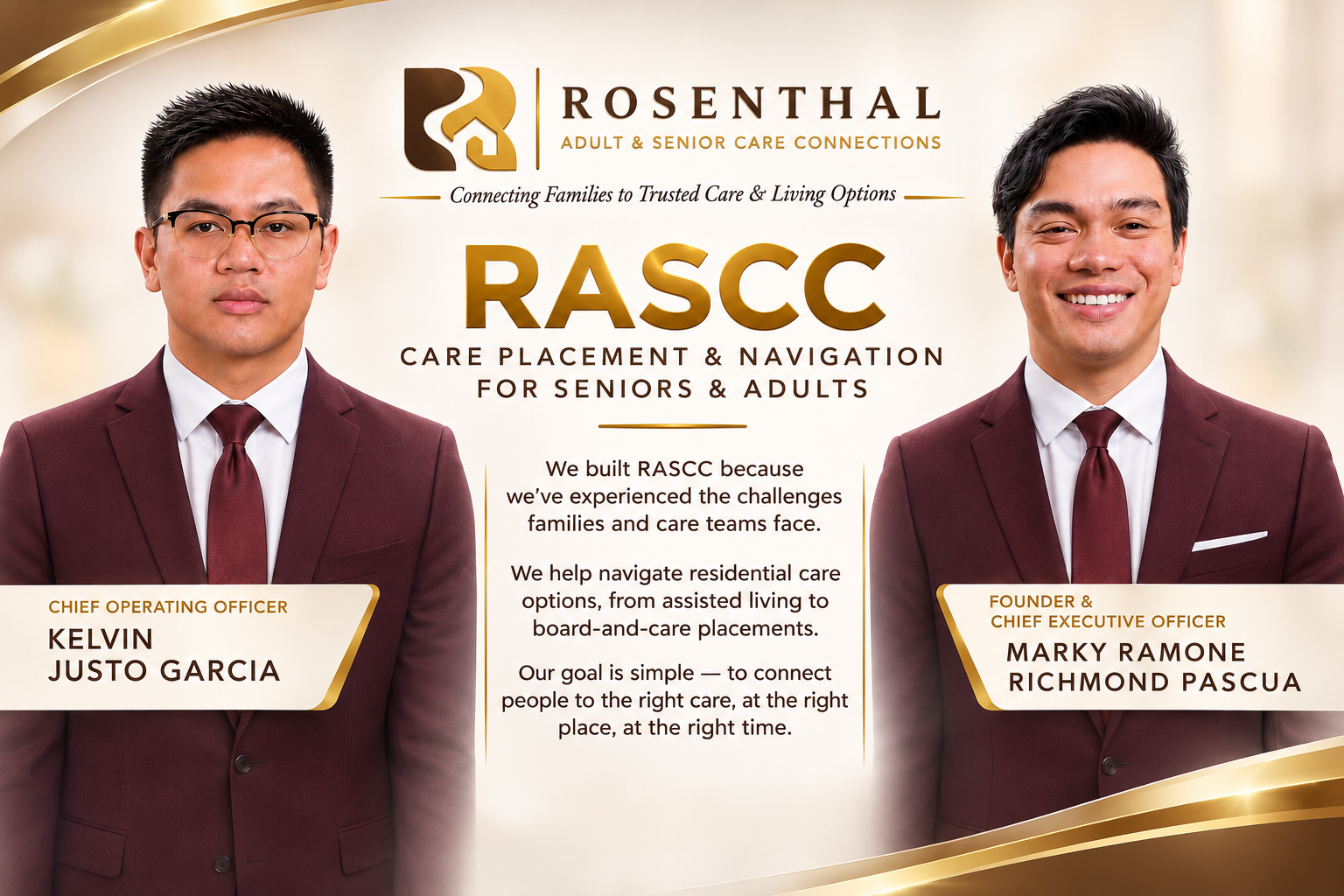
RASCC is part of The Rosenthal Care Group, led by Marky Ramone Richmond Pascua, Founder & Chief Executive Officer (CEO), and Kelvin Justo Garcia, Chief Operating Officer (COO).
Pascua's background includes more than a decade in corporate financial services, operations, and business development. Garcia oversees operational execution and systems that support the organization's referral and coordination work.
Their shared goal is to improve communication and coordination between families, discharge professionals, and residential care providers.
A Referral Resource for Discharge Professionals
RASCC welcomes inquiries from hospital case managers, discharge planners, social services directors, SNF social workers, rehabilitation facilities, and RCFE administrators handling challenging residential care transitions.
Families and residents are not charged a referral or placement fee by RASCC. Compensation may be arranged with participating providers.
Rosenthal Adult & Senior Care Connections (RASCC)
Website: www.rosenthalcareconnections.com
Email: marky.pascua@rosenthalcareconnections.com
Telephone: (888) 272-3301, Option 3
For a difficult hospital discharge, post-acute transition, or assisted living placement search in Southern California, RASCC can help explore the next appropriate step.

Socal Journal Contributor
Covers property and politics, following development, housing, and the decisions behind both.
This article features partner, contributor, or branded content from a third party. Members of the Socal Journal editorial staff were not involved in the creation of this content. All views and opinions are those of the contributor alone.
You May Also Like

Jamison Kaufman’s New Website Highlights a Creative Life Spanning Art, Design, and Publishing

Japan House LA Opens Major Japanese Craft Exhibition

Los Angeles VA Launches Veterans Day Celebrations

Los Angeles Celebrates Día De Los Muertos 2026 As Olvera Street Honors Family, Memory, And Mexican Heritage
Frances Lundmark Makes Federal Benefits Clear